Recursion#
Recursion solves a problem by breaking it into smaller instances of the same problem until a base case stops the chain. Every recursive call adds a frame to the call stack.
Core components#
| Part | Role |
|---|---|
| Base case | Simplest input; returns directly without further recursion |
| Recursive case | Calls the function on a strictly smaller / simpler input |
| Progress | Each step must move toward the base case (avoid infinite recursion) |
def factorial(n: int) -> int:
    if n <= 1:           # base case
        return 1
    return n * factorial(n - 1)   # recursive case; n decreases → progress
Time: O(n) — n recursive calls, O(1) work each.
Space: O(n) — call stack depth n.
Call stack intuition#
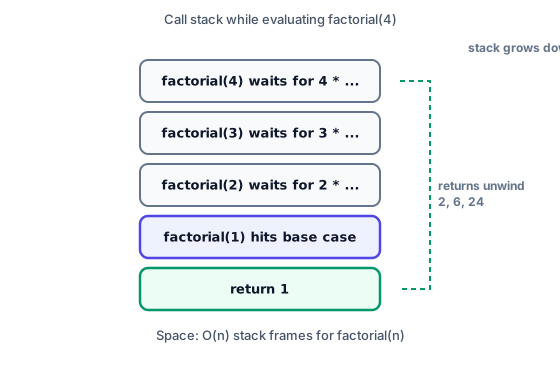
Each open call holds local variables until it returns. Deep recursion → stack overflow (Python default limit ~1000 frames, configurable).
When to use recursion#
| Prefer recursion | Prefer iteration |
|---|---|
| Trees and graphs (natural fit) | Simple linear loops |
| Divide-and-conquer (merge sort, quick sort) | Tail-recursive patterns easy to rewrite as loops |
| Backtracking (permutations, subsets) | Performance-critical hot paths with deep depth |
| Problem definition is inherently recursive | Stack depth may exceed limits |
Recurrence and complexity#
Many recursive algorithms cost T(n) = a·T(n/b) + f(n). Intuition (formalized by the Master Theorem):
| Pattern | Example | Typical time |
|---|---|---|
| Halve problem, O(1) combine | Binary search | O(log n) |
| Halve problem, O(n) combine | Merge sort | O(n log n) |
| Two half-sized subproblems + O(n) merge | Merge sort | O(n log n) |
| Single subproblem n−1 | Factorial, linear search | O(n) |
| Two subproblems size n−1 | Naive Fibonacci | O(2ⁿ) — needs memoization |
Space often equals maximum recursion depth × frame size, unless tail-call optimized (Python does not optimize tail calls).
Memoization (top-down dynamic programming)#
Cache subproblem results to avoid recomputation.
def fib(n: int, memo: dict[int, int] | None = None) -> int:
    if memo is None:
        memo = {}
    if n <= 1:
        return n
    if n in memo:
        return memo[n]
    memo[n] = fib(n - 1, memo) + fib(n - 2, memo)
    return memo[n]
Without memo: O(2ⁿ) time — exponential tree of calls.
With memo: O(n) time, O(n) space (cache + stack).
Head vs tail recursion#
Head recursion — recursive call happens, then more work on the way back (factorial).
Tail recursion — recursive call is the last operation; can be rewritten as a loop:
In Python, prefer explicit loops when depth is large.
Recursion on trees#
Tree traversals are the canonical recursive use case:
def tree_height(node) -> int:
    if node is None:
        return -1                    # base: empty tree
    return 1 + max(
        tree_height(node.left),
        tree_height(node.right),
    )
Time: O(n) — visit every node once.
Space: O(h) — h = height; worst O(n) for a skewed tree, O(log n) for balanced.
Backtracking template#
Try a choice, recurse, undo if it fails:
def backtrack(path, choices):
    if is_complete(path):
        record(path)
        return
    for choice in choices:
        if not is_valid(choice, path):
            continue
        path.append(choice)      # choose
        backtrack(path, next_choices)
        path.pop()               # unchoose
Time: often exponential in input size (all subsets/permutations).
Space: O(depth) stack plus O(depth) current path.
Common pitfalls#
- Missing base case — infinite recursion.
- Not progressing toward base case — same argument size recursed forever.
- Ignoring stack depth — skewed tree or deep backtracking may hit limits.
- Redundant subproblems without memo — exponential blow-up (Fibonacci, repeated grid paths).
Debugging checklist#
- What is the smallest input I can answer directly?
- Does each recursive call use a strictly smaller state?
- Can the same state be reached on multiple paths? → add memoization.
- What is stack depth in the worst case?
Related topics#
- Tree — recursive structure
- Complexity — recursion stack space O(depth)
- Dynamic Programming Intro — memoization
- Sorting — merge sort and quick sort use divide-and-conquer recursion
- Searching — recursive binary search variant
- Backtracking — choose / explore / unchoose
- Divide and Conquer — recursive split-and-combine
- Programming Overview