15. Heaps#
Python's heapq module implements a min-heap only. For max-heap behavior, negate numeric keys or push (-priority, item) tuples so the smallest negated value corresponds to the largest original value.
Problems at a glance#
| LC | Problem | |
|---|---|---|
| 215 | Kth Largest Element in an Array | ↗ |
| 973 | K Closest Points to Origin | ↗ |
| 347 | Top K Frequent Elements | ↗ |
| 692 | Top K Frequent Words | ↗ |
| 451 | Sort Characters By Frequency | ↗ |
| 767 | Reorganize String | ↗ |
| 358 | Rearrange String k Distance Apart | ↗ |
| 1167 | Minimum Cost to Connect Sticks | ↗ |
| 857 | Minimum Cost to Hire K Workers | ↗ |
| 871 | Minimum Number of Refueling Stops | ↗ |
| 1337 | The K Weakest Rows in a Matrix | ↗ |
| 1046 | Last Stone Weight | ↗ |
| 264 | Ugly Number II | ↗ |
| 480 | Sliding Window Median | ↗ |
| 295 | Find Median from Data Stream | ↗ |
| 502 | IPO / Maximize Capital | ↗ |
| 703 | Kth Largest Element in a Stream | ↗ |
| 253 | Meeting Rooms II | ↗ |
| 759 | Employee Free Time | ↗ |
| 621 | Task Scheduler | ↗ |
| 1642 | Furthest Building You Can Reach | ↗ |
| 630 | Course Schedule III | ↗ |
Core patterns#
| Pattern | Heap choice | When to use |
|---|---|---|
| Top K largest | Min-heap of size k |
Keep the k best; root is the worst of the k → evict when a better candidate arrives |
| Top K smallest | Max-heap of size k |
Mirror of above (negate keys in Python) |
| Two heaps | Max-heap (lower half) + min-heap (upper half) | Running median, sliding-window median |
| Merge streams | Min-heap seeded with stream heads | Ugly numbers, k-way interval merge |
| Scheduling / greedy | Min-heap of end times or max-heap of profits | Meeting rooms, refueling, task scheduler |
Template — top K largest:
import heapq
heap = []
for x in nums:
    heapq.heappush(heap, x)
    if len(heap) > k:
        heapq.heappop(heap)   # drop smallest → keep k largest
return heap[0]                # kth largest when k == len(heap)
Top 'K' Elements#
Problem 1: Kth Largest Element in an Array (Leetcode:215)#
Problem Statement
Given an integer array nums and an integer k, return the kth largest element in the array.
Note that it is the kth largest element in the sorted order, not the kth distinct element.
Can you solve it without sorting?
Example 1:
Input: nums = [3,2,1,5,6,4], k = 2
Output: 5
Example 2:
Input: nums = [3,2,3,1,2,4,5,5,6], k = 4
Output: 4
Constraints:
1 <= k <= nums.length <= 105-104 <= nums[i] <= 104
Code and Explanation
- Maintain a min-heap of size k. The root is the smallest among the k largest seen so far — exactly the kth largest.
- For each element, push it; if size exceeds k, pop the minimum (evict the weakest of the top k).
- Min-heap for k largest is the standard top-k trick — never sort the full array.
Time: O(n log k) · Space: O(k)
- Convert to (n − k)th smallest (0-indexed) and partition like quicksort.
- Recurse only into the half containing index k — average O(n), no heap needed.
- Preferred when O(n) average is required; heap is simpler and O(n log k) worst-case.
Time: O(n) average · Space: O(1)
Problem 2: K Closest Points to Origin (Leetcode:973)#
Problem Statement
Given an array of points where points[i] = [xi, yi] represents a point on the X-Y plane and an integer k, return the k closest points to the origin (0, 0).
The distance between two points on the X-Y plane is the Euclidean distance (i.e., √(x1 - x2)2 + (y1 - y2)2).
You may return the answer in any order. The answer is guaranteed to be unique (except for the order that it is in).
Example 1:
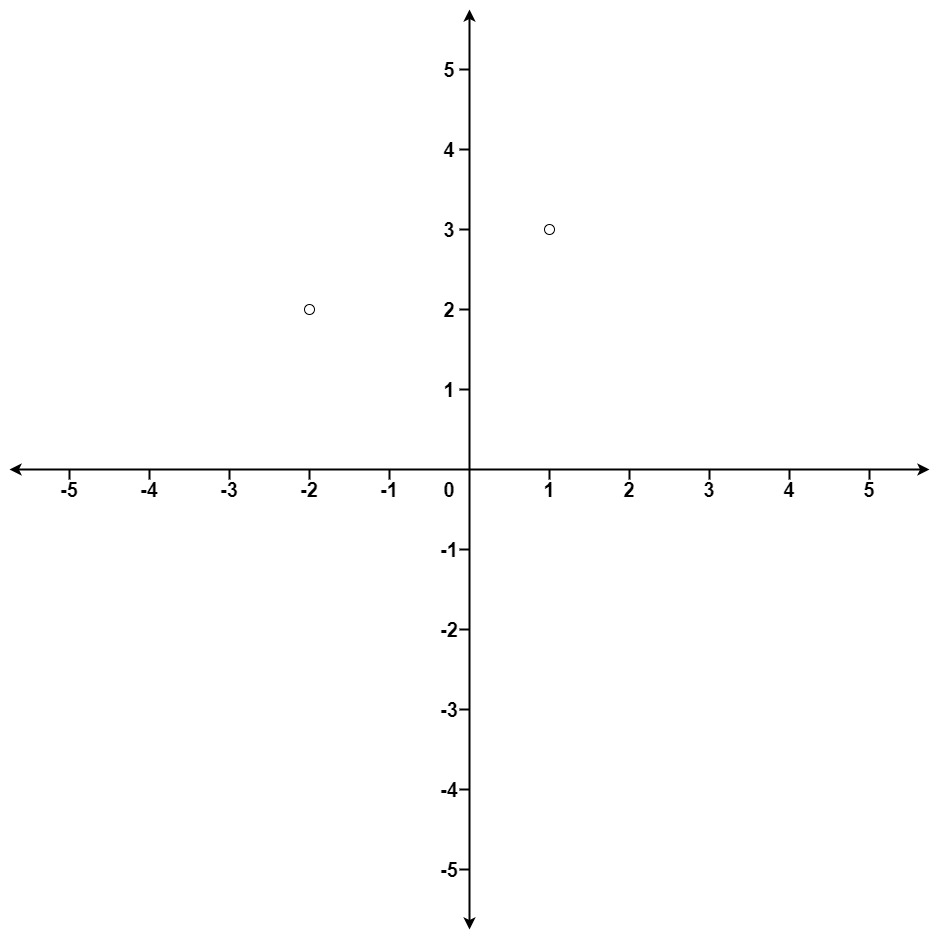
Input: points = [[1,3],[-2,2]], k = 1
Output: [[-2,2]]
Explanation:
The distance between (1, 3) and the origin is sqrt(10).
The distance between (-2, 2) and the origin is sqrt(8).
Since sqrt(8) < sqrt(10), (-2, 2) is closer to the origin.
We only want the closest k = 1 points from the origin, so the answer is just [[-2,2]].
Example 2:
Input: points = [[3,3],[5,-1],[-2,4]], k = 2
Output: [[3,3],[-2,4]]
Explanation: The answer [[-2,4],[3,3]] would also be accepted.
Constraints:
1 <= k <= points.length <= 104-104 <= xi, yi <= 104
Code and Explanation
- Compare by squared distance (no sqrt needed).
- Use
(-dist_sq, point)so Python's min-heap acts as a max-heap on distance — keep k closest by evicting the farthest when size > k. - Classic top-k smallest via negation trick.
Time: O(n log k) · Space: O(k)
- Sort all points by squared distance and take the first k.
- Simpler when k is close to n or heap overhead is not worth it.
Time: O(n log n) · Space: O(1) excluding output
Problem 3: Top K Frequent Elements (Leetcode:347)#
Problem Statement
Given an integer array nums and an integer k, return the k most frequent elements. You may return the answer in any order.
Example 1:
Input: nums = [1,1,1,2,2,3], k = 2
Output: [1,2]
Example 2:
Input: nums = [1], k = 1
Output: [1]
Constraints:
1 <= nums.length <= 105-104 <= nums[i] <= 104kis in the range[1, the number of unique elements in the array].- It is guaranteed that the answer is unique.
Follow up: Your algorithm's time complexity must be better than O(n log n), where n is the array's size.
Code and Explanation
- Count frequencies with
Counter. - Min-heap stores
(freq, num)— root has the smallest frequency among top k. - When heap exceeds size k, pop the weakest frequency. Remaining keys are the k most frequent.
Time: O(n + m log k) where m = unique elements · Space: O(m)
- Bucket index = frequency; frequency is at most n.
- Scan buckets from highest frequency down — O(n) when frequencies are bounded by n.
- Beats O(n log n) sorting; no heap needed.
Time: O(n) · Space: O(n)
Problem 4: Top K Frequent Words (Leetcode:692)#
Problem Statement
Given an array of strings words and an integer k, return the k most frequent strings.
Return the answer sorted by the frequency from highest to lowest. Sort the words with the same frequency by their lexicographical order.
Example 1:
Input: words = ["i","love","leetcode","i","love","coding"], k = 2
Output: ["i","love"]
Explanation: "i" and "love" are the two most frequent words.
Note that "i" comes before "love" due to a lower alphabetical order.
Example 2:
Input: words = ["the","day","is","sunny","the","the","the","sunny","is","is"], k = 4
Output: ["the","is","sunny","day"]
Explanation: "the", "is", "sunny" and "day" are the four most frequent words, with the number of occurrence being 4, 3, 2 and 1 respectively.
Constraints:
1 <= words.length <= 5001 <= words[i].length <= 10words[i]consists of lowercase English letters.kis in the range[1, The number of unique words[i]]
Follow-up: Could you solve it in O(n log(k)) time and O(n) extra space?
Code and Explanation
- Push
(-freq, word)— min-heap compares negated freq first (higher freq = smaller key). - On equal frequency, lexicographically smaller word has smaller tuple → kept over larger word.
- Final
sortedproduces output order: highest freq first, ties broken by lex order.
Time: O(n + m log k) · Space: O(m)
- Sort unique words by
(-frequency, word)and slice first k. - Straightforward when m is small (m ≤ 500 per constraints).
Time: O(m log m) · Space: O(m)
Problem 5: Sort Characters By Frequency (Leetcode:451)#
Problem Statement
Given a string s, sort it in decreasing order based on the frequency of the characters. The frequency of a character is the number of times it appears in the string.
Return the sorted string. If there are multiple answers, return any of them.
Example 1:
Input: s = "tree"
Output: "eert"
Explanation: 'e' appears twice while 'r' and 't' both appear once.
So 'e' must appear before both 'r' and 't'. Therefore "eetr" is also a valid answer.
Example 2:
Input: s = "cccaaa"
Output: "aaaccc"
Explanation: Both 'c' and 'a' appear three times, so both "cccaaa" and "aaaccc" are valid answers.
Note that "cacaca" is incorrect, as the same characters must be together.
Example 3:
Input: s = "Aabb"
Output: "bbAa"
Explanation: "bbaA" is also a valid answer, but "Aabb" is incorrect.
Note that 'A' and 'a' are treated as two different characters.
Constraints:
1 <= s.length <= 5 * 105sconsists of uppercase and lowercase English letters and digits.
Code and Explanation
- Push
(-freq, char)and heapify — min-heap on negated freq = max-heap on frequency. - Repeatedly pop highest frequency character and append it
freqtimes. - Same negation trick as top-k, but here we drain the entire heap.
Time: O(n log m) · Space: O(m)
- Place each character in bucket indexed by its frequency.
- Concatenate from highest bucket down — linear when freq ≤ n.
Time: O(n) · Space: O(n)
Problem 6: Reorganize String (Leetcode:767)#
Problem Statement
Given a string s, rearrange the characters of s so that any two adjacent characters are not the same.
Return any possible rearrangement of s or return "" if not possible.
Example 1:
Input: s = "aab"
Output: "aba"
Example 2:
Input: s = "aaab"
Output: ""
Constraints:
1 <= s.length <= 500sconsists of lowercase English letters.
Code and Explanation
- Impossible check: most frequent char cannot exceed
(n+1)//2slots. - Max-heap via
(-freq, ch)— always place the most frequent available char. - Hold one char in
prev(cooldown of 1) so the same letter is never adjacent.
Time: O(n log m) · Space: O(m)
- Fill even indices (0, 2, 4, …) then odd indices — guarantees no adjacency when feasible.
- No heap; same feasibility check as Approach 1.
Time: O(n log m) · Space: O(n)
Problem 7: Rearrange String k Distance Apart (Leetcode:358)#
Problem Statement
Given a string s and an integer k, rearrange s such that the same characters are at least distance k from each other. If it is not possible to rearrange the string, return an empty string "".
Example 1:
Input: s = "aabbcc", k = 3
Output: "abcabc"
Explanation: The same letters are at least a distance of 3 from each other.
Example 2:
Input: s = "aaabc", k = 3
Output: ""
Explanation: It is not possible to rearrange the string.
Example 3:
Input: s = "aaadbbcc", k = 2
Output: "abacabcd"
Explanation: The same letters are at least a distance of 2 from each other.
Constraints:
1 <= s.length <= 3 * 105sconsists of only lowercase English letters.0 <= k <= s.length
Code and Explanation
- Generalization of LC 767: same char must be k positions apart.
- Max-heap picks most frequent; chars on cooldown sit in a queue until
available_at_index. - If result length < |s|, some char could not be placed in time → return
"".
Time: O(n log m) · Space: O(m + k)
- Feasibility first: if the most frequent char needs more slots than exist with gap k, fail early.
- Construction is identical to Approach 1 — the heap pattern is the only practical builder for general k.
- Separating check from build clarifies why some inputs return
"".
Time: O(n log m) · Space: O(m + k)
Problem 8: Minimum Cost to Connect Sticks (Leetcode:1167)#
Problem Statement
You have n sticks of the given lengths. Your task is to connect all the sticks into one stick. Find the minimum cost of connecting all the given sticks.
The cost of connecting two sticks is the sum of their lengths. After connecting two sticks, you get one stick whose length is the sum of both sticks' lengths.
Example 1:
Input: sticks = [2,4,3]
Output: 14
Explanation: Merge 2 + 3 = 5 (cost 5), then 4 + 5 = 9 (cost 9). Total = 14.
Example 2:
Input: sticks = [1,8,3,5]
Output: 30
Example 3:
Input: sticks = [5]
Output: 0
Constraints:
1 <= sticks.length <= 1041 <= sticks[i] <= 104
Code and Explanation
- Always merge the two smallest sticks first — min-heap gives them in O(log n).
- Pay
a + beach merge; push combined stick back. - Same greedy structure as Huffman coding — smaller sticks participate in more merges, so merge them early.
Time: O(n log n) · Space: O(n)
- Same greedy logic but re-sort after each merge.
- Correct but O(n² log n) — illustrates why heap is preferred.
Time: O(n² log n) · Space: O(n)
Problem 9: Minimum Cost to Hire K Workers (Leetcode:857)#
Problem Statement
There are n workers. You are given two integer arrays quality and wage where quality[i] is the quality of the ith worker and wage[i] is the minimum wage expectation for the ith worker.
We want to hire exactly k workers to form a paid group. To hire a group of k workers, we must pay them according to the following rules:
- Every worker in the paid group must be paid at least their minimum wage expectation.
- In the group, each worker's pay must be directly proportional to their quality. This means if a worker’s quality is double that of another worker in the group, then they must be paid twice as much as the other worker.
Given the integer k, return the least amount of money needed to form a paid group satisfying the above conditions. Answers within 10-5 of the actual answer will be accepted.
Example 1:
Input: quality = [10,20,5], wage = [70,50,30], k = 2
Output: 105.00000
Explanation: We pay 70 to 0th worker and 35 to 2nd worker.
Example 2:
Input: quality = [3,1,10,10,1], wage = [4,8,2,2,7], k = 3
Output: 30.66667
Explanation: We pay 4 to 0th worker, 13.33333 to 2nd and 3rd workers separately.
Constraints:
n == quality.length == wage.length1 <= k <= n <= 1041 <= quality[i], wage[i] <= 104
Code and Explanation
- Sort workers by wage/quality ratio — the captain (highest ratio) sets pay for the group.
- For each captain, keep k workers with smallest quality sum via max-heap on quality (
-q). - Total cost =
captain_ratio × sum(qualities).
Time: O(n log n) · Space: O(k)
- Try every k-subset; compute required ratio and cost.
- O(C(n,k)) — only for understanding; heap + sort is the interview solution.
Time: O(C(n, k) · k) · Space: O(k)
Problem 10: Minimum Number of Refueling Stops (Leetcode:871)#
Problem Statement
A car travels from a starting position to a destination which is target miles east of the starting position.
There are gas stations along the way. The gas stations are represented as an array stations where stations[i] = [positioni, fueli] indicates that the ith gas station is positioni miles east of the starting position and has fueli liters of gas.
The car starts with an infinite tank of gas, which initially has startFuel liters of fuel in it. It uses one liter of gas per one mile that it drives. When the car reaches a gas station, it may stop and refuel, transferring all the gas from the station into the car.
Return the minimum number of refueling stops the car must make in order to reach its destination. If it cannot reach the destination, return -1.
Note that if the car reaches a gas station with 0 fuel left, the car can still refuel there. If the car reaches the destination with 0 fuel left, it is still considered to have arrived.
Example 1:
Input: target = 1, startFuel = 1, stations = []
Output: 0
Explanation: We can reach the target without refueling.
Example 2:
Input: target = 100, startFuel = 1, stations = [[10,100]]
Output: -1
Explanation: We can not reach the target (or even the first gas station).
Example 3:
Input: target = 100, startFuel = 10, stations = [[10,60],[20,30],[30,30],[60,40]]
Output: 2
Explanation: We start with 10 liters of fuel.
We drive to position 10, expending 10 liters of fuel. We refuel from 0 liters to 60 liters of gas.
Then, we drive from position 10 to position 60 (expending 50 liters of fuel),
and refuel from 10 liters to 50 liters of gas. We then drive to and reach the target.
We made 2 refueling stops along the way, so we return 2.
Constraints:
1 <= target, startFuel <= 1090 <= stations.length <= 5001 <= positioni < positioni+1 < target1 <= fueli < 109
Code and Explanation
- Drive as far as current fuel allows; push all reachable stations' fuel into a max-heap (
-fuel). - If you cannot reach target, retroactively refuel at the largest station passed (pop max).
- Greedy: using the biggest fuel tank among past options always maximizes future reach with fewest stops.
Time: O(n log n) · Space: O(n)
dp[j]= max fuel reachable with exactly j stops after processing stations.- Not heap-based; useful when you need exact reachability table.
- Approach 1 is the standard heap-greedy solution.
Time: O(n²) · Space: O(n)
Problem 11: The K Weakest Rows in a Matrix (Leetcode:1337)#
Problem Statement
You are given an m x n binary matrix mat of 1's (representing soldiers) and 0's (representing civilians). The soldiers are positioned in front of the civilians. That is, all the 1's will appear to the left of all the 0's in each row.
A row i is weaker than a row j if one of the following is true:
- The number of soldiers in row
iis less than the number of soldiers in rowj. - Both rows have the same number of soldiers and
i < j.
Return the indices of the k weakest rows in the matrix ordered from weakest to strongest.
Example 1:
Input: mat =
[[1,1,0,0,0],
[1,1,1,1,0],
[1,0,0,0,0],
[1,1,0,0,0],
[1,1,1,1,1]],
k = 3
Output: [2,0,3]
Explanation:
The number of soldiers in each row is:
- Row 0: 2
- Row 1: 4
- Row 2: 1
- Row 3: 2
- Row 4: 5
The rows ordered from weakest to strongest are [2,0,3,1,4].
Example 2:
Input: mat =
[[1,0,0,0],
[1,1,1,1],
[1,0,0,0],
[1,0,0,0]],
k = 2
Output: [0,2]
Explanation:
The number of soldiers in each row is:
- Row 0: 1
- Row 1: 4
- Row 2: 1
- Row 3: 1
The rows ordered from weakest to strongest are [0,2,3,1].
Constraints:
m == mat.lengthn == mat[i].length2 <= n, m <= 1001 <= k <= mmatrix[i][j]is either 0 or 1.
Code and Explanation
- Count soldiers per row with binary search (rows are sorted 1s then 0s).
- Use
(-cnt, -i, row_index)as max-heap key — evict strongest (or higher index on tie). - Sort remaining indices for output order weakest → stronger.
Time: O(m log n + m log k) · Space: O(k)
- Sort row indices by
(soldier_count, row_index). - Simpler when m ≤ 100; heap wins when m is large and k is small.
Time: O(m log m) · Space: O(m)
Problem 12: Last Stone Weight (Leetcode:1046)#
Problem Statement
You are given an array of integers stones where stones[i] is the weight of the ith stone.
We are playing a game with the stones. On each turn, we choose the heaviest two stones and smash them together. Suppose the heaviest two stones have weights x and y with x <= y. The result of this smash is:
- If
x == y, both stones are destroyed, and - If
x != y, the stone of weightxis destroyed, and the stone of weightyhas new weighty - x.
At the end of the game, there is at most one stone left.
Return the weight of the last remaining stone. If there are no stones left, return 0.
Example 1:
Input: stones = [2,7,4,1,8,1]
Output: 1
Explanation:
We combine 7 and 8 to get 1 so the array converts to [2,4,1,1,1] then,
we combine 2 and 4 to get 2 so the array converts to [2,1,1,1] then,
we combine 2 and 1 to get 1 so the array converts to [1,1,1] then,
we combine 1 and 1 to get 0 so the array converts to [1] then that's the value of the last stone.
Example 2:
Input: stones = [1]
Output: 1
Constraints:
1 <= stones.length <= 301 <= stones[i] <= 1000
Code and Explanation
- Negate all weights → min-heap acts as max-heap.
- Pop two heaviest; if unequal push difference back.
- Direct simulation of the game — each smash is O(log n).
Time: O(n log n) · Space: O(n)
- Sort and pop two largest each turn.
- O(n² log n) — fine for n ≤ 30 per constraints.
Time: O(n² log n) · Space: O(1)
Problem 13: Ugly Number II (Leetcode:264)#
Problem Statement
An ugly number is a positive integer whose prime factors are limited to 2, 3, and 5.
Given an integer n, return the nth ugly number.
Example 1:
Input: n = 10
Output: 12
Explanation: [1, 2, 3, 4, 5, 6, 8, 9, 10, 12] is the sequence of the first 10 ugly numbers.
Example 2:
Input: n = 1
Output: 1
Explanation: 1 has no prime factors, therefore all of its prime factors are limited to 2, 3, and 5.
Constraints:
1 <= n <= 1690
Code and Explanation
- Each ugly number spawns up to three streams (×2, ×3, ×5).
- Min-heap always yields the smallest unseen ugly number — classic merge k sorted streams.
seenset avoids duplicate pushes (e.g. 2×3 = 3×2).
Time: O(n log n) · Space: O(n)
- Three pointers into the ugly list — each tracks the next multiple of 2, 3, or 5.
- O(n) time, no heap; same merge-stream idea without priority queue overhead.
- See also K-way Merge doc for the pointer variant at scale.
Time: O(n) · Space: O(n)
Two Heaps#
Maintain a max-heap for the lower half and a min-heap for the upper half. Balance sizes so len(low) >= len(high) and len(low) <= len(high) + 1. Median = top of max-heap (odd) or average of both tops (even).
Problem 1: Sliding Window Median (Leetcode:480)#
Problem Statement
The median is the middle value in an ordered integer list. If the size of the list is even, there is no middle value. So the median is the mean of the two middle values.
- For examples, if
arr = [2,3,4], the median is3. - For examples, if
arr = [1,2,3,4], the median is(2 + 3) / 2 = 2.5.
You are given an integer array nums and an integer k. There is a sliding window of size k which is moving from the very left of the array to the very right. You can only see the k numbers in the window. Each time the sliding window moves right by one position.
Return the median array for each window in the original array. Answers within 10-5 of the actual value will be accepted.
Example 1:
Input: nums = [1,3,-1,-3,5,3,6,7], k = 3
Output: [1.00000,-1.00000,-1.00000,3.00000,5.00000,6.00000]
Explanation:
Window position Median
--------------- -----
[1 3 -1] -3 5 3 6 7 1
1 [3 -1 -3] 5 3 6 7 -1
1 3 [-1 -3 5] 3 6 7 -1
1 3 -1 [-3 5 3] 6 7 3
1 3 -1 -3 [5 3 6] 7 5
1 3 -1 -3 5 [3 6 7] 6
Example 2:
Input: nums = [1,2,3,4,2,3,1,4,2], k = 3
Output: [2.00000,3.00000,3.00000,3.00000,2.00000,3.00000,2.00000]
Constraints:
1 <= k <= nums.length <= 105-231 <= nums[i] <= 231 - 1
Code and Explanation
- Two heaps:
small(max via negation) = lower half;large(min-heap) = upper half. - Track logical sizes separately; lazy-delete removed values in
delayedand prune stale tops. - Median = root of max-heap (odd k) or average of both roots (even k).
Time: O(n log k) · Space: O(k)
- Balanced BST /
SortedListgives O(log k) add/remove with direct median access. - Simpler logic; requires external library. Two-heap + lazy delete is the stdlib heap pattern.
Time: O(n log k) · Space: O(k)
Problem 2: Find Median from Data Stream (Leetcode:295)#
Problem Statement
The median is the middle value in an ordered integer list. If the size of the list is even, there is no middle value, and the median is the mean of the two middle values.
- For example, for
arr = [2,3,4], the median is3. - For example, for
arr = [2,3], the median is(2 + 3) / 2 = 2.5.
Implement the MedianFinder class:
MedianFinder()initializes theMedianFinderobject.void addNum(int num)adds the integernumfrom the data stream to the data structure.double findMedian()returns the median of all elements so far. Answers within10-5of the actual answer will be accepted.
Example 1:
Input
["MedianFinder", "addNum", "addNum", "findMedian", "addNum", "findMedian"]
[[], [1], [2], [], [3], []]
Output
[null, null, null, 1.5, null, 2.0]Explanation
MedianFinder medianFinder = new MedianFinder();
medianFinder.addNum(1); // arr = [1]
medianFinder.addNum(2); // arr = [1, 2]
medianFinder.findMedian(); // return 1.5 (i.e., (1 + 2) / 2)
medianFinder.addNum(3); // arr[1, 2, 3]
medianFinder.findMedian(); // return 2.0
Constraints:
-105 <= num <= 105- There will be at least one element in the data structure before calling
findMedian.- At most
5 * 104calls will be made toaddNumandfindMedian.
Follow up:
- If all integer numbers from the stream are in the range
[0, 100], how would you optimize your solution?- If
99%of all integer numbers from the stream are in the range[0, 100], how would you optimize your solution?
Code and Explanation
- Every
addNumgoes tosmallfirst, then the largest ofsmallmoves tolarge. - Rebalance: if
largeis bigger, move its minimum back tosmall. - Invariant:
len(small) >= len(large)and differ by at most 1 → median at heap tops. No lazy delete needed (only inserts).
Time: O(log n) per add · Space: O(n)
- Keep a sorted array via
bisect.insort— O(n) per insert due to shifting. - Two-heap is strictly better at O(log n) per insert for large streams.
Time: O(n) per add · Space: O(n)
Problem 3: IPO / Maximize Capital (Leetcode:502)#
Problem Statement
Suppose LeetCode will start its IPO soon. In order to sell a good price of its shares to Venture Capital, LeetCode would like to work on some projects to increase its capital before the IPO. Since it has limited resources, it can only finish at most k distinct projects before the IPO. Help LeetCode design the best way to maximize its total capital after finishing at most k distinct projects.
You are given n projects where the ith project has a pure profit profits[i] and a minimum capital of capital[i] is needed to start it.
Initially, you have w capital. When you finish a project, you will obtain its pure profit and the profit will be added to your total capital.
Pick a list of at most k distinct projects from given projects to maximize your final capital, and return the final maximized capital.
The answer is guaranteed to fit in a 32-bit signed integer.
Example 1:
Input: k = 2, w = 0, profits = [1,2,3], capital = [0,1,1]
Output: 4
Explanation: Since your initial capital is 0, you can only start the project indexed 0.
After finishing it you will obtain profit 1 and your capital becomes 1.
With capital 1, you can either start the project indexed 1 or the project indexed 2.
Since you can choose at most 2 projects, you need to finish the project indexed 2 to get the maximum capital.
Therefore, output the final maximized capital, which is 0 + 1 + 3 = 4.
Example 2:
Input: k = 3, w = 0, profits = [1,2,3], capital = [0,1,2]
Output: 6
Constraints:
1 <= k <= 1050 <= w <= 109n == profits.lengthn == capital.length1 <= n <= 1050 <= profits[i] <= 1040 <= capital[i] <= 109
Code and Explanation
- Sort projects by minimum capital required.
- Push all affordable projects' profits into a max-heap (
-profit). - Each round: pick highest profit among affordable projects, add to capital, unlock more projects.
- Two-heap flavor: one sorted stream + one profit heap.
Time: O(n log n) · Space: O(n)
- Linear scan for best affordable project each of k rounds.
- O(nk) — heap version avoids repeated scans.
Time: O(nk) · Space: O(n)
Problem 4: Kth Largest Element in a Stream (Leetcode:703)#
Problem Statement
You are part of a university admissions office and need to keep track of the kth highest test score from applicants in real-time. This helps to determine cut-off marks for interviews and admissions dynamically as new applicants submit their scores.
You are tasked to implement a class which, for a given integer k, maintains a stream of test scores and continuously returns the kth highest test score after a new score has been submitted. More specifically, we are looking for the kth highest score in the sorted list of all scores.
Implement the KthLargest class:
KthLargest(int k, int[] nums)Initializes the object with the integerkand the stream of test scoresnums.int add(int val)Adds a new test scorevalto the stream and returns the element representing thekthlargest element in the pool of test scores so far.
Example 1:
Input:
["KthLargest", "add", "add", "add", "add", "add"]
[[3, [4, 5, 8, 2]], [3], [5], [10], [9], [4]]
Output: [null, 4, 5, 5, 8, 8]
Explanation:
KthLargest kthLargest = new KthLargest(3, [4, 5, 8, 2]);
kthLargest.add(3); // return 4
kthLargest.add(5); // return 5
kthLargest.add(10); // return 5
kthLargest.add(9); // return 8
kthLargest.add(4); // return 8
Example 2:
Input:
["KthLargest", "add", "add", "add", "add"]
[[4, [7, 7, 7, 7, 8, 3]], [2], [10], [9], [9]]
Output: [null, 7, 7, 7, 8]
Explanation:
KthLargest kthLargest = new KthLargest(4, [7, 7, 7, 7, 8, 3]);
kthLargest.add(2); // return 7
kthLargest.add(10); // return 7
kthLargest.add(9); // return 7
kthLargest.add(9); // return 8
Constraints:
0 <= nums.length <= 1041 <= k <= nums.length + 1-104 <= nums[i] <= 104-104 <= val <= 104- At most
104calls will be made toadd.
Code and Explanation
- Maintain min-heap of size k — root is always the kth largest in the stream.
- On each
add, push and evict smallest if over capacity. - Same top-k trick as LC 215, adapted for streaming.
Time: O(log k) per add · Space: O(k)
- Keep full sorted list; kth largest =
nums[-k]. - O(n) insert — only viable for tiny streams.
Time: O(n) per add · Space: O(n)
Scheduling Pattern#
Use heaps when the next decision depends on earliest finish time, highest priority task, or best available resource.
Problem 1: Meeting Rooms II (Leetcode:253)#
Problem Statement
Given an array of meeting time intervals intervals where intervals[i] = [starti, endi], return the minimum number of conference rooms required.
Example 1:
Input: intervals = [[0,30],[5,10],[15,20]]
Output: 2
Example 2:
Input: intervals = [[7,10],[2,4]]
Output: 1
Constraints:
1 <= intervals.length <= 1040 <= starti < endi <= 106
Code and Explanation
- Sort by start time. For each meeting, check if earliest-ending room is free (
heap[0] <= start). - Min-heap tracks end times — root = room available soonest.
- Heap size = concurrent meetings = minimum rooms needed.
Time: O(n log n) · Space: O(n)
- Two pointers on sorted starts and ends — increment rooms on start, decrement on end.
- Track peak concurrent count. No heap; same O(n log n) from sorting.
Time: O(n log n) · Space: O(n)
Problem 2: Employee Free Time (Leetcode:759)#
Problem Statement
We are given a list schedule of employees, which represents the working time for each employee.
Each employee has a list of non-overlapping Intervals, and these intervals are in sorted order.
Return the list of finite intervals representing common, positive-length free time for all employees, also in sorted order.
(Even though we are representing Intervals in the form [x, y], the objects inside are Intervals, not lists or arrays. For example, schedule[0][0].start = 1, schedule[0][0].end = 2, and schedule[0][0][0] is not defined. Also, we wouldn't include intervals like [5, 5] in our answer, as they have zero length.)
Example 1:
Input: schedule = [[[1,2],[5,6]],[[1,3]],[[4,10]]]
Output: [[3,4]]
Explanation: There are a total of three employees, and all common free time intervals would be [-inf, 1], [3, 4], [10, inf]. We discard any intervals that contain inf as they aren't finite.
Example 2:
Input: schedule = [[[1,3],[6,7]],[[2,4]],[[2,5],[9,12]]]
Output: [[5,6],[7,9]]
Constraints:
1 <= schedule.length , schedule[i].length <= 500 <= schedule[i].start < schedule[i].end <= 108
Code and Explanation
- Each employee's busy intervals form a sorted stream; seed a min-heap with each employee's first interval.
- Pop earliest-starting interval globally; gap between
prev_endand nextstartis shared free time. - Classic merge k sorted streams pattern.
Time: O(N log k) · Space: O(k)
- Collect all intervals, sort, merge overlaps, report gaps.
- O(N log N) — simpler; heap wins when streams are already per-employee sorted.
Time: O(N log N) · Space: O(N)
Problem 3: Task Scheduler (Leetcode:621)#
Problem Statement
You are given an array of CPU tasks, each labeled with a letter from A to Z, and a number n. Each CPU interval can be idle or allow the completion of one task. Tasks can be completed in any order, but there's a constraint: there has to be a gap of at least n intervals between two tasks with the same label.
Return the minimum number of CPU intervals required to complete all tasks.
Example 1:
Input: tasks = ["A","A","A","B","B","B"], n = 2
Output: 8
Explanation: A possible sequence is: A -> B -> idle -> A -> B -> idle -> A -> B.
After completing task A, you must wait two intervals before doing A again. The same applies to task B. In the 3rd interval, neither A nor B can be done, so you idle. By the 4th interval, you can do A again as 2 intervals have passed.
Example 2:
Input: tasks = ["A","C","A","B","D","B"], n = 1
Output: 6
Explanation: A possible sequence is: A -> B -> C -> D -> A -> B. With a cooling interval of 1, you can repeat a task after just one other task.
Example 3:
Input: tasks = ["A","A","A", "B","B","B"], n = 3
Output: 10
Explanation: A possible sequence is: A -> B -> idle -> idle -> A -> B -> idle -> idle -> A -> B. There are only two types of tasks, A and B, which need to be separated by 3 intervals. This leads to idling twice between repetitions of these tasks.
Constraints:
1 <= tasks.length <= 104tasks[i]is an uppercase English letter.0 <= n <= 100
Code and Explanation
- Max-heap on task counts (
-count) — always schedule the most frequent remaining task. - After scheduling, task sits in cooldown queue for
nslots (same pattern as reorganize string). - Time advances each tick; idle slots fill automatically when heap empty but cooldown pending.
Time: O(m log m) · Space: O(m)
- Arrange most frequent task as skeleton with
ngaps between repeats. min_slots= mandatory frame size; answer is max of that andlen(tasks).- No heap — faster O(m); heap approach generalizes when tie-breaking rules differ.
Time: O(m) · Space: O(1)
Problem 4: Furthest Building You Can Reach (Leetcode:1642)#
Problem Statement
You are given an integer array heights representing the heights of buildings, some bricks, and some ladders.
You start your journey from building 0 and move to the next building by possibly using bricks or ladders.
While moving from building i to building i+1 (0-indexed),
- If the current building's height is greater than or equal to the next building's height, you do not need a ladder or bricks.
- If the current building's height is less than the next building's height, you can either use one ladder or
(h[i+1] - h[i])bricks.
Return the furthest building index (0-indexed) you can reach if you use the given ladders and bricks optimally.
Example 1:
Input: heights = [4,2,7,6,9,14,12], bricks = 5, ladders = 1
Output: 4
Explanation: Starting at building 0, you can follow these steps:
- Go to building 1 without using ladders nor bricks since 4 >= 2.
- Go to building 2 using 5 bricks. You must use either bricks or ladders because 2 < 7.
- Go to building 3 without using ladders nor bricks since 7 >= 6.
- Go to building 4 using your only ladder. You must use either bricks or ladders because 6 < 9.
It is impossible to go beyond building 4 because you do not have any more bricks or ladders.

Example 2:
Input: heights = [4,12,2,7,3,18,20,3,19], bricks = 10, ladders = 2
Output: 7
Example 3:
Input: heights = [14,3,19,3], bricks = 17, ladders = 0
Output: 3
Constraints:
1 <= heights.length <= 1051 <= heights[i] <= 1060 <= bricks <= 1090 <= ladders <= heights.length
Code and Explanation
- Greedily use a ladder for every upward climb; track those climbs in a min-heap.
- When ladders exhausted, swap the cheapest ladder climb to bricks (pop smallest from heap).
- Min-heap keeps the
ladderslargest climbs on ladders — optimal resource allocation.
Time: O(n log ladders) · Space: O(ladders)
- Same ladder/brick swap logic but re-sort after each climb.
- O(n²) — heap avoids repeated sorting.
Time: O(n²) · Space: O(n)
Problem 5: Course Schedule III (Leetcode:630)#
Problem Statement
There are n different online courses numbered from 1 to n. You are given an array courses where courses[i] = [durationi, lastDayi] indicate that the ith course should be taken continuously for durationi days and must be finished before or on lastDayi.
You will start on the 1st day and you cannot take two or more courses simultaneously.
Return the maximum number of courses that you can take.
Example 1:
Input: courses = [[100,200],[200,1300],[1000,1250],[2000,3200]]
Output: 3
Explanation:
There are totally 4 courses, but you can take 3 courses at most:
First, take the 1st course, it costs 100 days so you will finish it on the 100th day, and ready to take the next course on the 101st day.
Second, take the 3rd course, it costs 1000 days so you will finish it on the 1100th day, and ready to take the next course on the 1101st day.
Third, take the 2nd course, it costs 200 days so you will finish it on the 1300th day.
The 4th course cannot be taken now, since you will finish it on the 3300th day, which exceeds the closed date.
Example 2:
Input: courses = [[1,2]]
Output: 1
Example 3:
Input: courses = [[3,2],[4,3]]
Output: 0
Constraints:
1 <= courses.length <= 1041 <= durationi, lastDayi <= 104
Code and Explanation
- Sort by deadline (Earliest Deadline First).
- Greedily take each course; if total time exceeds deadline, drop the longest course taken so far (max-heap).
- Max-heap lets you undo the costliest choice — maximize count of feasible courses.
Time: O(n log n) · Space: O(n)
- Backtracking over sorted courses — exponential.
- Illustrates the greedy invariant; heap solution is required for n up to 10⁴.
Time: O(2^n) · Space: O(n)