09. Binary Search#
Theory#
Binary search requires a monotonic predicate: once f(i) becomes true, it stays true (or the opposite for upper-bound variants). The array being sorted is the classic case — f(i) = (nums[i] >= target).
Three templates#
| Goal | Invariant | Typical loop |
|---|---|---|
| Exact match | lo <= hi |
return -1 if not found |
| Lower bound (first true) | lo < hi, shrink hi |
mid = (lo+hi)//2; if pred(mid): hi=mid else lo=mid+1 |
| Upper bound (last false) | same as lower bound on negated pred | return lo |
def lower_bound(nums, target):
    lo, hi = 0, len(nums)
    while lo < hi:
        mid = (lo + hi) // 2
        if nums[mid] >= target:
            hi = mid
        else:
            lo = mid + 1
    return lo
Binary search on the answer space#
When the problem asks to minimize the maximum or maximize the minimum, binary search the answer range, not the array:
- Identify monotonic feasibility:
can(x)= "is answer x achievable?" - Binary search the smallest/largest x where
can(x)is true.
Examples: LC 875 (Koko eating bananas), LC 1011 (capacity to ship), LC 410 (split array largest sum).
Pitfalls#
- Use
mid = lo + (hi - lo) // 2to avoid overflow (habit; Python ints are fine but interviewers notice). - Clarify inclusive vs exclusive
hi— off-by-one bugs are the #1 failure mode. - Duplicates: lower bound finds first occurrence; upper bound finds insertion point after run.
See also: Searching.
Problems at a glance#
| LC | Problem | |
|---|---|---|
| 704 | Binary Search | ↗ |
| 35 | Search Insert Position | ↗ |
| 852 | Peak Index in a Mountain Array | ↗ |
| 34 | Find First and Last Position of Element in Sorted Array | ↗ |
| 875 | Koko Eating Bananas | ↗ |
| 410 | Split Array Largest Sum | ↗ |
| 1011 | Capacity To Ship Packages Within D Days | ↗ |
| 1283 | Find the Smallest Divisor Given a Threshold | ↗ |
| 33 | Search in Rotated Sorted Array | ↗ |
| 81 | Search in Rotated Sorted Array II | ↗ |
| 300 | Longest Increasing Subsequence | ↗ |
| 744 | Find Smallest Letter Greater Than Target | ↗ |
| 278 | First Bad Version | ↗ |
| 162 | Find Peak Element | ↗ |
| 69 | Sqrt(x) | ↗ |
| 74 | Search a 2D Matrix | ↗ |
1. Classic Binary Search#
Problem 1: Binary Search (Leetcode:704)#
Problem Statement
Given an array of integers nums which is sorted in ascending order, and an integer target, write a function to search target in nums. If target exists, then return its index. Otherwise, return -1.
You must write an algorithm with O(log n) runtime complexity.
Example 1:
Input: nums = [-1,0,3,5,9,12], target = 9
Output: 4
Explanation: 9 exists in nums and its index is 4
Example 2:
Input: nums = [-1,0,3,5,9,12], target = 2
Output: -1
Explanation: 2 does not exist in nums so return -1
Constraints:
1 <= nums.length <= 104-104 < nums[i], target < 104- All the integers in
numsare unique.numsis sorted in ascending order.
Code and Explanation
- Maintain a closed interval
[lo, hi]that always contains the target if it exists. - Compare
nums[mid]totargetand discard the half that cannot contain the answer. - Stop when the interval is empty (
lo > hi), returning-1.
Time: O(log n) | Space: O(1)
- Use the lower bound template: find the first index where
nums[i] >= target. - Half-open range
[lo, hi)withhi = len(nums)avoids off-by-one when the target is larger than all elements. - After the loop, check whether
nums[lo]actually equalstarget.
Time: O(log n) | Space: O(1)
Problem 2: Search Insert Position (Leetcode:35)#
Problem Statement
Given a sorted array of distinct integers and a target value, return the index if the target is found. If not, return the index where it would be if it were inserted in order.
You must write an algorithm with O(log n) runtime complexity.
Example 1:
Input: nums = [1,3,5,6], target = 5
Output: 2
Example 2:
Input: nums = [1,3,5,6], target = 2
Output: 1
Example 3:
Input: nums = [1,3,5,6], target = 7
Output: 4
Constraints:
1 <= nums.length <= 104-104 <= nums[i] <= 104numscontains distinct values sorted in ascending order.-104 <= target <= 104
Code and Explanation
- The answer is exactly the lower bound of
target: the first index wherenums[i] >= target. - If
targetis present, that index is its position; otherwise it is the insertion point. - No extra check is needed because
lois always a valid insertion index in[0, len(nums)].
Time: O(log n) | Space: O(1)
- Standard exact-match binary search; when the loop ends without a match,
lopoints to the insertion index. - Example:
target = 2in[1,3,5,6]— after discarding smaller values,lostops at index1. - Equivalent to lower bound but written with the inclusive
[lo, hi]template.
Time: O(log n) | Space: O(1)
Problem 3: Peak Index in a Mountain Array (Leetcode:852)#
Problem Statement
You are given an integer mountain array arr of length n where the values increase to a peak element and then decrease.
Return the index of the peak element.
Your task is to solve it in O(log(n)) time complexity.
Example 1:
Input: arr = [0,1,0]
Output: 1
Example 2:
Input: arr = [0,2,1,0]
Output: 1
Example 3:
Input: arr = [0,10,5,2]
Output: 1
Constraints:
3 <= arr.length <= 1050 <= arr[i] <= 106arris guaranteed to be a mountain array.
Code and Explanation
- Compare
arr[mid]witharr[mid + 1]to detect whether we are on the ascending or descending side. - If ascending (
arr[mid] < arr[mid + 1]), the peak is at or to the right — movelo = mid + 1. - Otherwise the peak is at
midor to the left — shrink withhi = mid. - Invariant: the peak index is always in
[lo, hi].
Time: O(log n) | Space: O(1)
- Walk left to right until the first index where the next value is smaller — that index is the peak.
- Correct but O(n); included to contrast with the logarithmic binary search approach.
- Useful when the array is tiny or as a sanity check while learning the BS variant.
Time: O(n) | Space: O(1)
2. First / Last Occurrence#
Problem 1: Find First and Last Position of Element in Sorted Array (Leetcode:34)#
Problem Statement
Given an array of integers nums sorted in non-decreasing order, find the starting and ending position of a given target value.
If target is not found in the array, return [-1, -1].
You must write an algorithm with O(log n) runtime complexity.
Example 1:
Input: nums = [5,7,7,8,8,10], target = 8
Output: [3,4]
Example 2:
Input: nums = [5,7,7,8,8,10], target = 6
Output: [-1,-1]
Example 3:
Input: nums = [], target = 0
Output: [-1,-1]
Constraints:
0 <= nums.length <= 105-109 <= nums[i] <= 109numsis a non-decreasing array.-109 <= target <= 109
Code and Explanation
- Lower bound finds the first index with
nums[i] >= target; verify it equalstarget. - Upper bound finds the first index with
nums[i] > target; the last occurrence is one before that. - Two O(log n) searches handle duplicate runs without scanning the whole array.
Time: O(log n) | Space: O(1)
- Binary search finds any occurrence of
targetin O(log n). - Expand left and right while neighbors still equal
target. - Worst case O(n) when all elements are
target, but simple when duplicate runs are short.
Time: O(log n) best, O(n) worst | Space: O(1)
Problem 2: Count Occurrences of a Number in a Sorted Array (GeeksforGeeks)#
Problem Statement
Given a sorted array arr[] and a number x, find the number of occurrences of x in arr[].
Example 1:
Input: arr = [1, 1, 1, 2, 3, 3, 3, 3], x = 3
Output: 4
Example 2:
Input: arr = [5, 7, 7, 8, 8, 10], x = 7
Output: 2
Example 3:
Input: arr = [1, 2, 4, 4, 4, 4, 7, 9], x = 4
Output: 4
Constraints:
1 <= arr.length <= 105arris sorted in non-decreasing order
Code and Explanation
- Count equals the length of the duplicate run:
upper_bound(x) - lower_bound(x). - Lower bound gives the first index; upper bound gives the insertion point after the last
x. - Handles absent elements by checking
arr[first] != x.
Time: O(log n) | Space: O(1)
- Because the array is sorted, equal elements form a contiguous block.
- Count matches while scanning; stop early once
num > x. - O(n) but easy to reason about; binary search wins on large arrays with long duplicate runs.
Time: O(n) | Space: O(1)
3. Binary Search on Answer (Search Space)#
Problem 1: Koko Eating Bananas (Leetcode:875)#
Problem Statement
Koko loves to eat bananas. There are n piles of bananas, the ith pile has piles[i] bananas. The guards have gone and will come back in h hours.
Koko can decide her bananas-per-hour eating speed of k. Each hour, she chooses some pile of bananas and eats k bananas from that pile. If the pile has less than k bananas, she eats all of them instead and will not eat any more bananas during this hour.
Koko likes to eat slowly but still wants to finish eating all the bananas before the guards return.
Return the minimum integer k such that she can eat all the bananas within h hours.
Example 1:
Input: piles = [3,6,7,11], h = 8
Output: 4
Example 2:
Input: piles = [30,11,23,4,20], h = 5
Output: 30
Example 3:
Input: piles = [30,11,23,4,20], h = 6
Output: 23
Constraints:
1 <= piles.length <= 104piles.length <= h <= 1091 <= piles[i] <= 109
Code and Explanation
- Predicate:
can(k) = (total hours at speed k <= h). Faster speed makes this easier — monotonic. - Search the minimum feasible
kin[1, max(piles)]. - Validation scans all piles once per BS step: O(n log max(piles)).
Time: O(n log max(piles)) | Space: O(1)
- Try every speed from
1upward until one finishes withinhhours. - Same validation function as Approach 1, but no binary search on the answer range.
- Correct but O(n · max(piles)) — shows why BS on the answer space matters.
Time: O(n · max(piles)) | Space: O(1)
Problem 2: Split Array Largest Sum (Leetcode:410)#
Problem Statement
Given an integer array nums and an integer k, split nums into k non-empty subarrays such that the largest sum of any subarray is minimized.
Return the minimized largest sum of the split.
A subarray is a contiguous part of the array.
Example 1:
Input: nums = [7,2,5,10,8], k = 2
Output: 18
Explanation: There are four ways to split nums into two subarrays.
The best way is to split it into [7,2,5] and [10,8], where the largest sum among the two subarrays is only 18.
Example 2:
Input: nums = [1,2,3,4,5], k = 2
Output: 9
Explanation: There are four ways to split nums into two subarrays.
The best way is to split it into [1,2,3] and [4,5], where the largest sum among the two subarrays is only 9.
Constraints:
1 <= nums.length <= 10000 <= nums[i] <= 1061 <= k <= min(50, nums.length)
Code and Explanation
- Binary search the answer: minimum largest subarray sum in
[max(nums), sum(nums)]. can_split(limit)greedily packs elements until adding the next would exceedlimit, then starts a new part.- If we need more than
kparts,limitis too small.
Time: O(n log sum(nums)) | Space: O(1)
- Same greedy validator, but try every candidate limit from smallest to largest.
- First feasible limit is the answer because the predicate is monotonic.
- O(n · sum(nums)) — impractical for large sums; BS reduces the search to logarithmic steps.
Time: O(n · sum(nums)) | Space: O(1)
Problem 3: Capacity To Ship Packages Within D Days (Leetcode:1011)#
Problem Statement
A conveyor belt has packages that must be shipped from one port to another within days days.
The ith package on the conveyor belt has a weight of weights[i]. Each day, we load the ship with packages on the conveyor belt (in the order given by weights). We may not load more weight than the maximum weight capacity of the ship.
Return the least weight capacity of the ship that will result in all the packages on the conveyor belt being shipped within days days.
Example 1:
Input: weights = [1,2,3,4,5,6,7,8,9,10], days = 5
Output: 15
Explanation: A ship capacity of 15 is the minimum to ship all the packages in 5 days like this:
1st day: 1, 2, 3, 4, 5
2nd day: 6, 7
3rd day: 8
4th day: 9
5th day: 10Note that the cargo must be shipped in the order given, so using a ship of capacity 14 and splitting the packages into parts like (2, 3, 4, 5), (1, 6, 7), (8), (9), (10) is not allowed.
Example 2:
Input: weights = [3,2,2,4,1,4], days = 3
Output: 6
Explanation: A ship capacity of 6 is the minimum to ship all the packages in 3 days like this:
1st day: 3, 2
2nd day: 2, 4
3rd day: 1, 4
Example 3:
Input: weights = [1,2,3,1,1], days = 4
Output: 3
Explanation:
1st day: 1
2nd day: 2
3rd day: 3
4th day: 1, 1
Constraints:
1 <= days <= weights.length <= 5 * 1041 <= weights[i] <= 500
Code and Explanation
- Search minimum capacity in
[max(weights), sum(weights)]. - Greedy validation: pack packages in order until capacity is exceeded, then start a new day.
- Identical structure to LC 410 — minimize the maximum load subject to a partition count.
Time: O(n log sum(weights)) | Space: O(1)
- Try every capacity starting from the heaviest single package.
- First capacity that fits within
daysis optimal because more capacity only helps. - Linear scan over the answer range; BS replaces this with O(log sum) steps.
Time: O(n · sum(weights)) | Space: O(1)
Problem 4: Find the Smallest Divisor Given a Threshold (Leetcode:1283)#
Problem Statement
Given an array of integers nums and an integer threshold, we will choose a positive integer divisor, divide all the array by it, and sum the division's result. Find the smallest divisor such that the result mentioned above is less than or equal to threshold.
Each result of the division is rounded to the nearest integer greater than or equal to that element. (For example: 7/3 = 3 and 10/2 = 5).
The test cases are generated so that there will be an answer.
Example 1:
Input: nums = [1,2,5,9], threshold = 6
Output: 5
Explanation: We can get a sum to 17 (1+2+5+9) if the divisor is 1.
If the divisor is 4 we can get a sum of 7 (1+1+2+3) and if the divisor is 5 the sum will be 5 (1+1+1+2).
Example 2:
Input: nums = [44,22,33,11,1], threshold = 5
Output: 44
Constraints:
1 <= nums.length <= 5 * 1041 <= nums[i] <= 106nums.length <= threshold <= 106
Code and Explanation
- Larger divisor → smaller ceiling-sum → easier to meet
threshold. Search minimum feasible divisor. - Upper bound
max(nums)works because dividing by it gives sumn <= threshold(guaranteed by problem). - Validation is a linear scan computing
ceil(num / d)for each element.
Time: O(n log max(nums)) | Space: O(1)
- Try divisors
1, 2, 3, …until the ceiling-sum drops tothresholdor below. - Same validation as Approach 1 without binary search on the answer.
- O(n · max(nums)) — acceptable only when values are small.
Time: O(n · max(nums)) | Space: O(1)
4. Binary Search in Rotated Sorted Array#
Problem 1: Search in Rotated Sorted Array (Leetcode:33)#
Problem Statement
There is an integer array nums sorted in ascending order (with distinct values).
Prior to being passed to your function, nums is possibly left rotated at an unknown index k (1 <= k < nums.length) such that the resulting array is [nums[k], nums[k+1], ..., nums[n-1], nums[0], nums[1], ..., nums[k-1]] (0-indexed). For example, [0,1,2,4,5,6,7] might be left rotated by 3 indices and become [4,5,6,7,0,1,2].
Given the array nums after the possible rotation and an integer target, return the index of target if it is in nums, or -1 if it is not in `nums*.
You must write an algorithm with O(log n) runtime complexity.
Example 1:
Input: nums = [4,5,6,7,0,1,2], target = 0
Output: 4
Example 2:
Input: nums = [4,5,6,7,0,1,2], target = 3
Output: -1
Example 3:
Input: nums = [1], target = 0
Output: -1
Constraints:
1 <= nums.length <= 5000-104 <= nums[i] <= 104- All values of
numsare unique.numsis an ascending array that is possibly rotated.-104 <= target <= 104
Code and Explanation
- At each step, one half of
[lo, hi]is a normal sorted segment. - Check whether
targetlies in the sorted half; if yes, search there, else discard that half. nums[lo] <= nums[mid]identifies which side is sorted (use<=becauselo == midis possible).
Time: O(log n) | Space: O(1)
- Phase 1: find the rotation pivot (minimum element) with binary search.
- Phase 2: decide which sorted segment contains
target, then run classic binary search there. - Still O(log n) but two passes; Approach 1 is more compact for interviews.
Time: O(log n) | Space: O(1)
Problem 2: Search in Rotated Sorted Array II (Leetcode:81)#
Problem Statement
There is an integer array nums sorted in non-decreasing order (not necessarily with distinct values).
Before being passed to your function, nums is rotated at an unknown pivot index k (0 <= k < nums.length) such that the resulting array is [nums[k], nums[k+1], ..., nums[n-1], nums[0], nums[1], ..., nums[k-1]] (0-indexed). For example, [0,1,2,4,4,4,5,6,6,7] might be rotated at pivot index 5 and become [4,5,6,6,7,0,1,2,4,4].
Given the array nums after the rotation and an integer target, return true if target is in nums, or false if it is not in nums.
You must decrease the overall operation steps as much as possible.
Example 1:
Input: nums = [2,5,6,0,0,1,2], target = 0
Output: true
Example 2:
Input: nums = [2,5,6,0,0,1,2], target = 3
Output: false
Constraints:
1 <= nums.length <= 5000-104 <= nums[i] <= 104numsis guaranteed to be rotated at some pivot.-104 <= target <= 104
Follow up: This problem is similar to Search in Rotated Sorted Array, but nums may contain duplicates. Would this affect the runtime complexity? How and why?
Code and Explanation
- Same rotated-array logic as LC 33, but when
nums[lo] == nums[mid] == nums[hi], we cannot tell which side is sorted. - Shrink boundaries with
lo += 1; hi -= 1— worst case degrades to O(n). - Follow-up answer: duplicates can force linear time because equal values at both ends hide the pivot.
Time: O(log n) average, O(n) worst | Space: O(1)
- Simple O(n) scan; always correct regardless of duplicates.
- When many duplicates cluster at the boundaries, BS may also approach O(n), so the gap narrows.
- In practice, Approach 1 still skips large sorted runs in O(log n) on typical inputs.
Time: O(n) | Space: O(1)
5. Lower Bound / Upper Bound#
Problem 1: Longest Increasing Subsequence (Leetcode:300)#
Problem Statement
Given an integer array nums, return the length of the longest strictly increasing subsequence**.
Example 1:
Input: nums = [10,9,2,5,3,7,101,18]
Output: 4
Explanation: The longest increasing subsequence is [2,3,7,101], therefore the length is 4.
Example 2:
Input: nums = [0,1,0,3,2,3]
Output: 4
Example 3:
Input: nums = [7,7,7,7,7,7,7]
Output: 1
Constraints:
1 <= nums.length <= 2500-104 <= nums[i] <= 104
Follow up: Can you come up with an algorithm that runs in O(n log(n)) time complexity?
Code and Explanation
dp[i]= length of LIS ending at indexi.- For each
i, extend every earlierjwherenums[j] < nums[i]. - Correct baseline before optimizing with lower bound on a tails array.
Time: O(n²) | Space: O(n)
tails[len]= smallest tail value of any increasing subsequence of lengthlen + 1.- For each
num, lower bound (bisect_left) finds where to place it intails. - If
numexceeds all tails, extend LIS length; otherwise replace to keep tails minimal. - Length of
tailsis the LIS length — classic lower_bound application outside sorted input arrays.
Time: O(n log n) | Space: O(n)
Problem 2: Find Smallest Letter Greater Than Target (Leetcode:744)#
Problem Statement
You are given an array of lowercase letters letters sorted in non-decreasing order, and a character target. There will be at least one letter in the array that is lexicographically greater than target.
Return the smallest character in the array that is lexicographically greater than target.
Example 1:
Input: letters = ["c","f","j"], target = "a"
Output: "c"
Example 2:
Input: letters = ["c","f","j"], target = "c"
Output: "f"
Example 3:
Input: letters = ["x","x","y","y"], target = "z"
Output: "x"
Explanation: Wrap-around: no letter is greater thanz, so return the smallest letter.
Constraints:
2 <= letters.length <= 104letters[i]is a lowercase English letter.lettersis sorted in non-decreasing order.letterscontains at least two different characters.targetis a lowercase English letter.
Code and Explanation
- Find the first index where
letters[i] > target— lower bound on the strict predicate> target(not>=). - If
lo == len(letters), every letter is<= target; wrap withlo % len(letters). - Direct application of the upper-bound / first-greater template from the theory section.
Time: O(log n) | Space: O(1)
- Scan sorted letters until finding the first character greater than
target. - If none found, return
letters[0]for circular wrap-around. - O(n) but trivial to implement; binary search matters on large inputs.
Time: O(n) | Space: O(1)
6. Predicate / Boolean Function#
Problem 1: First Bad Version (Leetcode:278)#
Problem Statement
You are a product manager and currently leading a team to develop a new product. Unfortunately, the latest version of your product fails the quality check. Since each version is developed based on the previous version, all the versions after a bad version are also bad.
Suppose you have n versions [1, 2, ..., n] and you want to find out the first bad one, which causes all the following ones to be bad.
You are given an API bool isBadVersion(version) which returns whether version is bad. Implement a function to find the first bad version. You should minimize the number of calls to the API.
Example 1:
Input: n = 5, bad = 4
Output: 4
Explanation:
call isBadVersion(3) -> false
call isBadVersion(5) -> true
call isBadVersion(4) -> true
Then 4 is the first bad version.
Example 2:
Input: n = 1, bad = 1
Output: 1
Constraints:
1 <= bad <= n <= 231 - 1
Code and Explanation
- Predicate
isBadVersion(v)is false…false, true…true — classic lower bound on a boolean array. - If
midis bad, the first bad version is at or beforemid→hi = mid. - Minimizes API calls to O(log n).
Time: O(log n) | Space: O(1)
- Check versions
1, 2, 3, …until the first bad one. - O(n) API calls — unacceptable when
nis up to 2³¹. - Shows why predicate binary search is the intended pattern here.
Time: O(n) | Space: O(1)
Problem 2: Find Peak Element (Leetcode:162)#
Problem Statement
A peak element is an element that is strictly greater than its neighbors.
Given a 0-indexed integer array nums, find a peak element, and return its index. If the array contains multiple peaks, return the index to any of the peaks.
You may imagine that nums[-1] = nums[n] = -∞. In other words, an element is always considered to be strictly greater than a neighbor that is outside the array.
You must write an algorithm that runs in O(log n) time.
Example 1:
Input: nums = [1,2,3,1]
Output: 2
Explanation: 3 is a peak element and your function should return the index number 2.
Example 2:
Input: nums = [1,2,1,3,5,6,4]
Output: 5
Explanation: Your function can return either index number 1 where the peak element is 2, or index number 5 where the peak element is 6.
Constraints:
1 <= nums.length <= 1000-231 <= nums[i] <= 231 - 1nums[i] != nums[i + 1]for all validi.
Code and Explanation
- If
nums[mid] < nums[mid + 1], a peak must exist to the right (ascending slope). - Otherwise a peak is at
midor to the left — sethi = mid. - Virtual
-∞boundaries guarantee a peak exists; adjacent elements are distinct.
Time: O(log n) | Space: O(1)
- Return the first index where the next value is smaller — a local peak.
- O(n) but straightforward; binary search exploits the slope monotonicity property.
Time: O(n) | Space: O(1)
Problem 3: Sqrt(x) (Leetcode:69)#
Problem Statement
Given a non-negative integer x, return the square root of x rounded down to the nearest integer. The returned integer should be non-negative as well.
You must not use any built-in exponent function or operator.
- For example, do not use
pow(x, 0.5)in c++ orx ** 0.5in python.
Example 1:
Input: x = 4
Output: 2
Explanation: The square root of 4 is 2, so we return 2.
Example 2:
Input: x = 8
Output: 2
Explanation: The square root of 8 is 2.82842..., and since we round it down to the nearest integer, 2 is returned.
Constraints:
0 <= x <= 231 - 1
Code and Explanation
- Search the largest integer
midsuch thatmid * mid <= x— binary search on the answer space[1, x // 2]. - Predicate
mid * mid <= xis monotonic; use upper-mid bias when shrinkingloto prevent stalling. - Handle
x = 0andx = 1as base cases.
Time: O(log x) | Space: O(1)
- Increment
answhile(ans + 1)² <= x. - Returns floor(sqrt(x)) but takes O(√x) steps — fine for small
x, not for 2³¹. - Contrasts with logarithmic search on the integer answer range.
Time: O(√x) | Space: O(1)
7. 2D Binary Search#
Problem 1: Search a 2D Matrix (Leetcode:74)#
Problem Statement
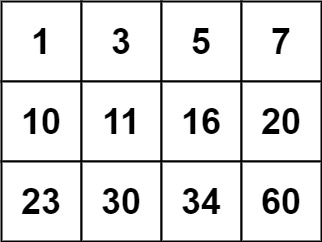
You are given an m x n integer matrix matrix with the following two properties:
- Each row is sorted in non-decreasing order.
- The first integer of each row is greater than the last integer of the previous row.
Given an integer target, return true if target is in matrix or false otherwise.
You must write a solution in O(log(m * n)) time complexity.
Example 1:
Input: matrix = [[1,3,5,7],[10,11,16,20],[23,30,34,60]], target = 3
Output: true

Example 2:
Input: matrix = [[1,3,5,7],[10,11,16,20],[23,30,34,60]], target = 13
Output: false
Constraints:
m == matrix.lengthn == matrix[i].length1 <= m, n <= 100-104 <= matrix[i][j], target <= 104
Code and Explanation
- Row-major order makes the matrix behave like a sorted 1D array of length
m * n. - Map flat index
midto(mid // n, mid % n). - Standard binary search on the virtual array achieves O(log(mn)).
Time: O(log(mn)) | Space: O(1)
- Binary search rows by comparing
targetwith the first and last element of each row. - Once the candidate row is found, binary search within that row.
- Still O(log m + log n) = O(log(mn)); more intuitive when thinking row-by-row.
Time: O(log m + log n) | Space: O(1)