Searching#
Searching means locating a target value (or its position) inside a collection. The right algorithm depends on whether the data is sorted and whether you need one answer or all occurrences.
Comparison#
| Algorithm | Preconditions | Time | Space | When to use |
|---|---|---|---|---|
| Linear search | None | O(n) | O(1) | Unsorted data; small n; single scan |
| Binary search | Sorted array | O(log n) | O(1) iterative | Sorted data; large n; find exact value or boundary |
Linear search#
Scan every element until you find the target or exhaust the array.
def linear_search(arr: list, target) -> int:
    for index, value in enumerate(arr):
        if value == target:
            return index
    return -1
Time: O(n) worst and average — each element checked once.
Space: O(1) — only an index variable.
When to use:
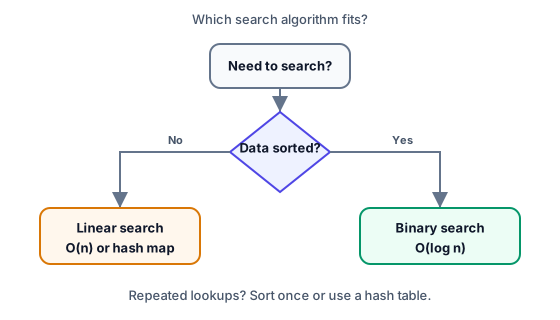
- The array is not sorted (sorting first costs O(n log n), often not worth it for one query).
- You need the first occurrence in original order.
- The list is small (constant size); simplicity beats log factors.
Limitations: Repeated searches on the same unsorted array are expensive; consider sorting once + binary search, or building a hash map for O(1) lookups.
Binary search#
Requires a sorted array (or a monotonic predicate — “first index where condition becomes true”). Compare against the middle element and discard half the search space each step.
def binary_search(arr: list, target) -> int:
    left, right = 0, len(arr) - 1
    while left <= right:
        mid = left + (right - left) // 2  # avoids overflow in other languages
        if arr[mid] == target:
            return mid
        if arr[mid] < target:
            left = mid + 1
        else:
            right = mid - 1
    return -1
Time: O(log n) — halve the interval each iteration; at most ⌊log₂ n⌋ + 1 comparisons.
Space: O(1) iterative; O(log n) if implemented recursively (call stack).
When to use:
- Data is already sorted or sorting cost is amortized over many queries.
- You need O(log n) lookup in a static array.
- The problem reduces to “find the boundary” (first ≥ x, last ≤ x) on a monotonic sequence — the same template applies with adjusted equality checks.
Why mid = left + (right - left) // 2#
Equivalent to (left + right) // 2 but safe when indices are large (relevant in C++/Java; good habit in Python too).
Iterative vs recursive#
| Style | Space | Notes |
|---|---|---|
| Iterative | O(1) | Preferred in interviews |
| Recursive | O(log n) stack | Mirrors the mathematical definition |
Linear vs binary — decision guide#
Common misconceptions#
- Binary search on unsorted data — incorrect; you must sort first (O(n log n)) or use linear / hashing.
- Binary search only finds exact matches — the same loop finds lower bound, upper bound, and insertion point by changing the update rule and return value.
- Linear search is always bad — for tiny arrays or one-off scans, the constant overhead of binary search may not matter.
Related topics#
- Complexity — O(log n) binary search analysis
- Sorting — prerequisite for binary search on arrays
- 09. Binary Search — full pattern + LC problems
- Binary Search Tree — dynamic sorted structure
- Hashing — O(1) average lookup without ordering requirement
- Programming Overview